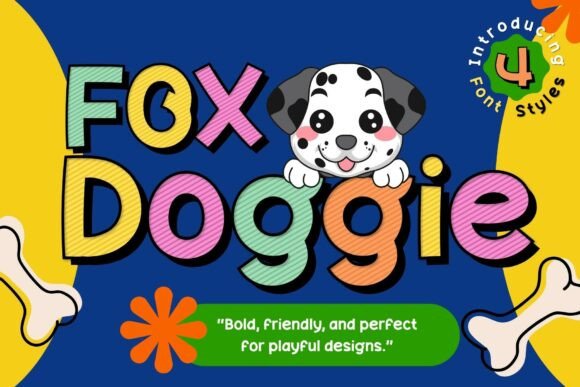
Fox Doggie: A Playful Font Family for Creative Design Projects
When selecting a typeface for a design project, especially one aimed at a younger or more whimsical audience, the right font can make a significant difference in tone and engagement. Fox Doggie is a versatile font family designed with charm and character, making it a strong contender for a variety of creative applications. With four distinct styles—Regular, Strokes, Outline, and Shadow—this typeface offers flexibility without sacrificing personality.
Understanding the Design and Use Cases of Fox Doggie
The Fox Doggie font family stands out due to its bold, rounded letterforms and a consistent bubbly vibe. Each of the four included styles serves a unique purpose, allowing designers to layer and combine them for visual interest. The Regular style offers a clean, readable base. The Strokes version introduces subtle line details that add texture without overwhelming the design. The Outline and Shadow styles provide depth and dimension, ideal for titles or standout elements.
This font family is particularly well-suited for children’s books, stickers, game interfaces, posters, and playful packaging. Its character-driven design brings warmth and approachability to any layout, making it a practical choice for projects where friendliness and visual appeal are key. The font’s texture and layering options also make it adaptable for both print and digital environments.
How Fox Doggie Stacks Up Against Similar Fonts
When compared to other playful fonts, Fox Doggie offers a balanced combination of style variety and usability. Many similar fonts focus on a single aesthetic—either rounded and bubbly or more structured and whimsical—but Fox Doggie integrates both visual appeal and functional design. This versatility allows it to perform well in scenarios where a single font needs to carry multiple visual roles.
For example, some comparable fonts may offer only a single weight or style, limiting their adaptability. Others may lean heavily into cartoonish aesthetics, which can be limiting in more refined or mixed-audience contexts. Fox Doggie, by contrast, maintains a sense of fun while remaining grounded enough for broader use. Its layered styles can be combined for emphasis or contrast, giving designers more creative freedom without needing to switch between multiple fonts.
Strengths of Fox Doggie
- Versatile Styles: Four included variations allow for creative layering and mixing.
- Strong Visual Identity: The font’s bubbly, bold look makes it ideal for playful branding and design.
- Good Readability: Despite its decorative nature, the font remains legible at various sizes.
- Texture and Depth: The Strokes and Shadow styles add dimension without being overly complex.
Considerations and Tradeoffs
While Fox Doggie excels in many creative scenarios, it may not be the best fit for every project. Its playful nature, while a strength in appropriate contexts, could be a limitation in more formal or serious design applications. For example, business reports, academic publications, or corporate branding materials typically require a more neutral or professional typeface.
Additionally, designers who need extensive language support or a broader range of weights and widths may find Fox Doggie somewhat limited. It’s optimized for short-form text and display use rather than long blocks of body copy. In such cases, pairing it with a complementary sans-serif or serif font may be necessary to maintain both visual appeal and readability.
When Fox Doggie Is the Right Choice
If your project involves illustrated books, toy packaging, educational apps, or themed branding, Fox Doggie is likely a strong match. It works especially well when you need a typeface that can serve both as a design element and a communication tool. For instance, a children’s game app might use the Shadow style for titles and the Outline version for interactive buttons, creating a cohesive yet dynamic visual language.
Designers who appreciate character-driven fonts and enjoy mixing styles will find Fox Doggie particularly useful. Its built-in variety reduces the need to source multiple fonts for different design elements, streamlining the workflow while maintaining visual consistency. It’s also an excellent option for those who want to add a touch of personality without straying too far into novelty territory.
When Another Option Might Be Better
There are situations where a more restrained or versatile typeface may be preferable. If your design requires multilingual support, a wide range of weights, or compatibility with minimalist aesthetics, you may want to explore other font families. Some alternatives offer a broader typographic range, allowing for more nuanced design applications across different media.
Additionally, if your project leans toward a retro, vintage, or hand-drawn style, you might find fonts that are more tailored to those specific aesthetics. While Fox Doggie has a distinctive charm, it may not align with every visual direction. In such cases, evaluating the broader font landscape and considering how a typeface supports your brand or message is essential.
Practical Comparisons and Real-World Applications
To better understand where Fox Doggie fits within the design ecosystem, consider how it compares to other popular playful fonts. Some similar typefaces may offer only one or two styles, making Fox Doggie’s four-style approach more flexible. However, others may provide more extensive language support or better adaptability for responsive design.
For example, when designing a sticker collection for a stationery brand, using the Outline and Shadow styles together can create a pop-art effect that draws attention. Alternatively, in a children’s book layout, the Regular and Strokes versions can be layered to highlight different characters or moods. These practical applications demonstrate how Fox Doggie can enhance design without overshadowing the content.
Final Thoughts: Choosing the Right Typeface for Your Project
Selecting the right font is more than just a stylistic decision—it’s about aligning the typeface with the tone, audience, and purpose of the project. Fox Doggie offers a compelling combination of charm, flexibility, and readability that makes it a valuable asset for creative professionals. Its four distinct styles allow for expressive design while maintaining a cohesive identity.
However, as with any design choice, it’s important to evaluate whether Fox Doggie truly fits your needs. Consider the context, audience, and medium before making a final decision. By understanding both its strengths and limitations, you’ll be better equipped to determine whether this bubbly, character-rich font is the ideal choice for your next project.